HOW HORNS CREATES ADVANTAGES
In this section, we are going to focus on one action.
Horns is one of the most common actions in basketball —
from youth teams to the NBA.
That's because it teaches how offence is supposed to work.
Horns starts with:
- the ball at the top
- two players at the elbows (the "horns")
- two players spaced on the floor
From this alignment, the offence can:
- set a screen
- hand the ball off
- flow into pick and roll
- attack either side of the floor
Horns doesn't tell you exactly what will happen.
It gives you multiple chances to create an advantage.
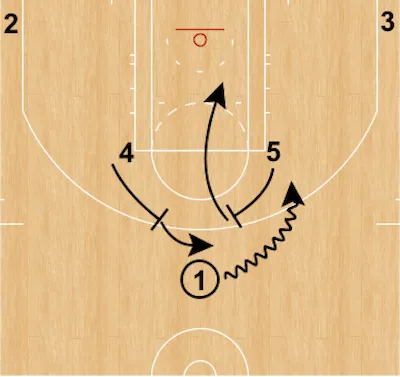
Horns puts pressure on the defence before the dribble even starts.
Because of where everyone begins:
- the defence must decide which side to protect
- help defenders are already close
- switching becomes harder
That means the offence is closer to creating:
- a 2-on-1
- a paint touch
- a rotation
Horns forces decisions early.
Horns works by layering simple advantages, one after another.
The basic Horns action:
1. One elbow player sets a screen
2. The ball handler attacks off the screen
3. The goal is to get downhill toward the paint
If the defence:
- doesn't help → score
- helps → pass to the open player
This is the same advantage logic you already know.
Horns does not change your reads.
It gives you more ways to punish the defence.
Roll — If the screener's defender steps up, the screener rolls to the basket. This forces help and creates a layup or an easy pass.
Pop — If the defence over-helps or blitzes the ball, the screener pops to open space. This creates an open shot without needing to drive.
Second-side involvement — Because there are two players at the elbows, help defenders are stretched, rotations are harder, and someone is usually left open.
As you watch, notice that:
- the action is simple
- the reads look familiar
- baskets come from help and rotations
- most shots are easy
The offence is not trying to trick the defence.
It is forcing the defence to choose.
Horns is not about memorizing patterns.
The reads are the same reads you already know from pick and roll:
- Can I score?
- Is the roll open?
- Did help come for a kick-out or skip pass?
Those reads never change.
Horns adds one important extra option. Because a second big starts at the elbow, you also have the pop. If the defence blitzes, over-helps, or gets confused — the pop player is often left open. That's not a trick. It's the defence choosing to protect the paint and giving something else up.
Horns is not the goal. It is the starting point. Once the advantage appears, everything you've already learned applies. Same advantage. Same reads. More ways to score.